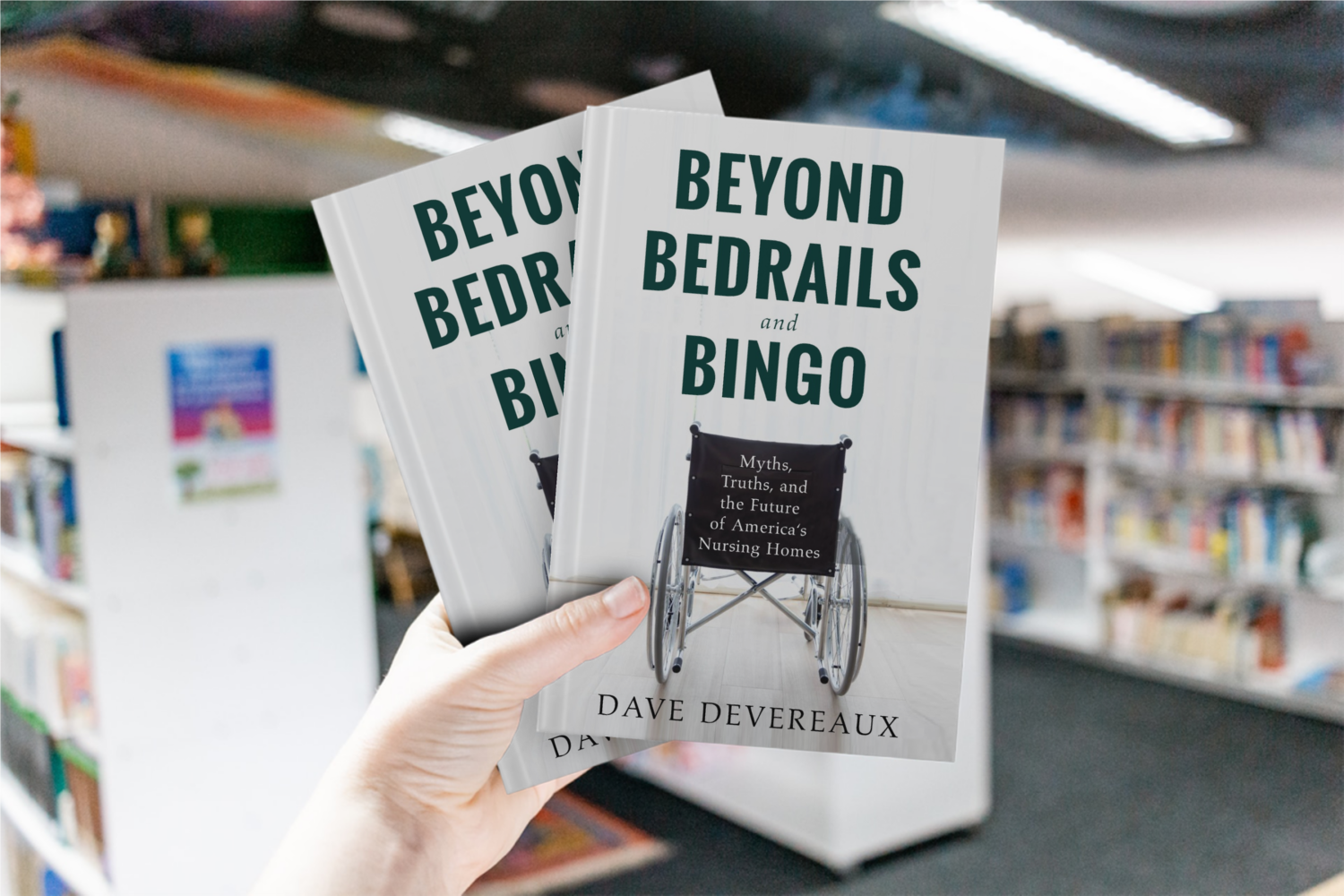

Beyond Bedrails and Bingo
What happens when the nursing home systems designed to care for our parents, our neighbors, and our own selves break down?
With 1.3 million Americans in nursing home care, 99 percent of facilities reporting staÿng shortages, and patient costs now exceeding $120,000 annually, the gap between our values and our systems has never been wider—or more dangerous.
Whether you’re an administrator navigating impossible decisions, a policymaker crafting legislation, or an investor evaluating opportunities in senior care, or an individual seeking the best possible care for a loved one—this book separates facts from fiction with unprecedented candor. Drawing on nearly fifty years of experience—from teenage housekeeper to C-suite executive, Dave Devereaux provides the insider perspective that industry professionals wish they could share publicly and that curious readers rarely get to see.
“Overall, this is an intelligent, detailed, and informative guide, and a must-have when making care home decisions. Very highly recommended.”
—Jamie Michele, Readers’ Favorite

FAQ
-
Our values—in print and conversation—frequently tout respecting, honoring, protecting, and empowering our seniors. Laudable, though in conflict with what is visible in everyday living. Men and women, aged 75 and older, working multiple shifts weekly in big-box supercenters, grocery stores, assisted living facilities, and nursing homes. Why? Because gaps in wealth and income make it impossible to cover the costs associated with food, housing, medications, and transportation, without this late-life supplemental income. For seniors lacking the access, energy, or capacity to earn this income, their destinies are determined by the services they may be eligible for, rather than deserving—which can be a most disrespecting series of final years.
-
Wow. These two questions are well suited to underpin a sequel to Beyond Bedrails and Bingo. The modern nursing home industry wouldn’t exist without the Social Security Amendments of 1965, which established Medicare and Medicaid as public health insurance programs.
Now, if the ability to travel back in time existed, imagine applying what is known today in deliberations and decisions made sixty years ago. Would lawmakers and taxpayers—given the current state of access, quality, satisfaction, cost, fraud, and abuse—wish for a do-over? I think probably so.
-
Nursing homes are among the most dynamic, complex, and emotional businesses in the U.S. Patient needs, demands, and behaviors can change in an instant. Margins for error are minute. Workforces vary by department, shift, tenure, compensation, and individual. Expectations are constantly high, among families, advocates, regulators, litigators, policy makers, executives, and owners. And surprisingly, the vast majority of decision makers and influencers in this industry have spent little to no time working in a nursing home—ever.
-
I view it as a trust problem. Patient families and advocates, state and federal regulators, and legislators don’t trust providers. Providers don’t trust regulators, agency bureaucrats, the media, or payors. And taxpayers don’t seem to trust anyone. It’s hard to build and maintain an industry with agility and durability where integrity of all parties is frequently questioned.
-
If one examined the work done by the Institute of Medicine’s Committee on Nursing Home Regulation in 1986 (which is highlighted in the book) there are features of senior care which remain unchanged in forty years. I don’t believe this will remain the case in the next decade or two. Existing momentum in generational aging, declining birth rates, fragile state and federal balance sheets, workforce indifference, and technological advancement will change the senior care’s industrial complexion.
Well-funded and expertly-led providers will prosper and pay cents on the dollar for assets owned by those who can’t (or won’t) compete. Consumers will increasingly value healthspan over lifespan, demanding an experience different than what’s been historically offered. When offerings are less than consumer expectations, they will decide to take their chances living at home—with increasingly substantial risk—until they are left with no choice.
Existing senior care offerings, like assisted and independent living, will threaten skilled nursing beyond historical norms, using technology solutions and design features to provide options that aging physical structures can’t accommodate.
And companies like Apptronik, Boston Dynamics, or Tesla will provide an increasing supply of the senior care workforce—in one’s home—challenging the existing and future spectrum of institutional providers.
-
My journey, which differed substantially from contemporaries, peers, and superiors, taught me that off-peak shifts (evenings and nights) and weekends (Friday evenings until Monday morning) often determined a nursing home’s quality, personality, and performance. These time frames—which encompass over seventy-five percent of a working week—frequently involved reduced staffing levels and leadership in the home, frequent visitors, and no relaxation in patient needs or demands. As a result, any collision between these variables could result in massive dissatisfaction, errors, and injuries related to issues in execution or responsiveness.
Predictably, best leaders within the industry learned and knew this, and built their management teams, patient care approaches, and business model with this in mind. On the other hand, my journey also included numerous leaders or executives who failed to embrace this dynamic and rarely set foot in a nursing home outside of Monday-Friday daylight hours.
-
Closed door conversations within companies routinely center around sales and marketing efforts to increase patient census and mix, outstanding payments due from Medicare, Medicaid, and other third-party payors, fortifying related-party ancillary company revenues through increased nursing home patient demand, achieving/maintaining compliance with lender covenants, or building the desired enterprise-wide culture.
What’s shocking, however, is that conversations are rarely exclusively devoted to nursing and patient care. These conversations usually occur departmentally or with other disciplines, rather than among a broad spectrum of subject-matter experts and executive leaders. Frankly, the science and practice of nursing intimidate most nursing home people, as it requires a baseline knowledge of principles beyond their respective interest or capacity.
-
Guilt is a real, and constant, emotion in health care. It’s hard to imagine anyone being spared in this moral quandary. Families can constantly wrestle with the choice to admit a loved one to a nursing home, as if in doing so is evidence of a lack of love for the person who becomes a patient. Additionally, guilt can accompany “unchecked baggage”, which would include conversations not had, unspoken sentiments, or deeply buried secrets.
Among caregivers, guilt can occur due to the perceived inability to do enough—or everything—for an individual or group of patients. While it is impossible for a caregiver to be all things to all people, ever, it doesn’t erase the intention or desire to do more, and be more, for the people they serve.
Administrators are not immunized from this experience. Their guilt is multifold. The challenges of delivering excellent results in patient care, people management, and business results requires the ability to say ‘YES’ and ‘NO’ when necessary. Like an umpire, calls (or decisions) made risk upsetting fifty percent of the people, one hundred percent of the time. Whether calls turn out to be right or wrong, guilt can be inherent with the act of making the call.
Additionally, and this also applies to Directors of Nursing, there can be tremendous guilt associated with the commitment and unpredictability associated with the lack of control an administrator has over the element of time. As nursing homes are never closed, demands of these leaders are constant, and a single text or phone call can interrupt (or derail) anything planned with family and friends. When these interruptions occur, the guilt associated with absence and sacrifice can be overpowering and long-lasting.
-
It’s similar to that of a team going nowhere near the end of a regular season. People are tired, miserable, and can go weeks without a day off. Overtime pay is insufficiently compensatory for the time present and effort expended. Incomplete work piles up. Risks of injury and illness, among caregivers and patients, multiply. Execution suffers, especially in tasks requiring speed and accuracy. And patients frequently don’t receive the care and attention they deserve.
-
If you’d asked me this question when I was younger, I’d have certainly provided a different — and less informed response. Now, approaching my mid-60’s, with more work and life experience, I’d suggest that the scope and depth of the issues, resistance to long-term change among stakeholders, and the demand that there be no “losers” make meaningful reform and redesign daunting.
Imagining what redesigning from scratch might look like, however, is a worthwhile exercise because miracles do happen, right? The first feature in this project would be examining and creating a set of impactful incentives that recognize and reward wellness, resulting in extending need for chronic care for as long as possible. Whether the condition is obesity, diabetes, or mental illness, for example, any set of incentives that extend the healthspan of one’s life would be beneficial at scale.
Second, design a financing mechanism that provides people with the access and ability to choose providers. With insolvency of Social Security and Medicare virtually guaranteed in the near future, it’s arguable that plenty of legislators didn’t do (or adjust for) the math, seize available opportunities decades ago, or make decisions that might rapidly limit their terms in power. Any do-over would use these lessons as reference and incent everyday people to start early in building the financial strength that allows them to determine their own health care destinies.
Last, and maybe most thought provoking, is to truly create a competitive environment. Today, it seems that the idea of losing is exclusive to losers, and to many this idea is unthinkable. I think of it very differently, and at the risk of showing my age, view losing —like winning —as exclusive to competitors. Any redesign would include incentives for competition, such as eliminating restrictive certificates of need, for example.
-
This one is easy—and rapidly becoming more personal. Better is when people can safely and consistently access what they need, when they need it, at a price equal to value without sacrificing quality, at home or as close to home as possible.
-
This book is for people interested in becoming better informed about a critical part of the nation’s health care landscape and its players, learning how it was, how it is, and how it might end up becoming.
-
I hope it encourages people to think differently about how they take care of themselves and their loved ones as they get older. I hope it empowers them to examine options, methods, and institutions with curiosity and confidence. And I hope it inspires people to make subtle—or massive—adjustments that preserve independence and self-determination.